While being a call operator for the emergency services is vitally important in keeping the public safe, police control rooms can be stressful and overwhelming due to understaffing, traumatic calls and abuse from the public. In addition to these challenges, police operators often simply don’t have the context they need to arrange the most appropriate help for a caller, which can have terrible consequences for victims.
Chris, a member of the Guardian team at Motorola Solutions, has experienced the pressures of a police control room firsthand. He was an operator at one of the busiest police services in the UK for over 17 years. We had a chat with him to understand the challenge that missing context can present for those in the control room and on the front line – and how built-in contact management can transform their operations.
The challenge: No time to gather information
Chris explains, “In a busy control room, you’re dealing with hundreds of incidents every shift – you learn how to plug gaps and change your thought process very quickly.” Due to the high volume of calls routed to police specifically – over 11 million in 2024 alone – the team members taking calls often faced a dilemma. “Calls were constantly being added to the queue, and we had no information about the caller. We would start asking questions and digging into various systems – but if we were dealing with a high-stakes ongoing call, we just didn’t have time to start looking at other databases. That meant we were approaching the call in isolation, which wasn’t helpful when it came to assessing the risk and vulnerability of the caller.”
As a result, the call takers would often pass the incident onto the dispatchers with minimal information, which meant the dispatchers had to start researching the caller themselves. Often, because call takers didn’t have the full picture, they referred incidents for deployment which could have been resolved over the phone. On the flip side, unless a call results in deployment, the information pertaining to the call isn’t entered into the force’s Computer-Aided Dispatch (CAD) system and is therefore lost – by some estimates, that could account for up to 40% of calls. As Chris puts it: “The only way to get that data would be by listening to historic calls, but we were simply too busy; no one had the bandwidth to do that.”
The solution: Automatically linking – and presenting – data
For police call handlers to categorise and prioritise incidents appropriately, they need easy access to caller details while still on the call itself. That’s why we built contact management directly into Guardian ICCS, so call takers can quickly view information about the caller as drawn from the force’s CAD, RMS and contact management database. Instead of manually trawling through information or previous calls, this data is presented automatically in an easy-to-read format – no user intervention needed.
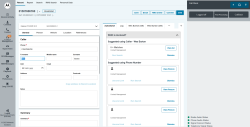
Chris emphasises the massive impact that this could have on police control rooms, saying: “Suddenly I can see all this information just from a telephone number. I can see that this person has called 20 times today already, or maybe they’re particularly vulnerable. Having that context would be absolutely critical.” He also thinks the tool would improve collaboration between call takers and dispatchers, and enable forces to distribute their resources more efficiently: “Giving call takers that data automatically as soon as they pick up the phone means they’ll be more empowered to decide whether a call should actually result in deployment or not.”
Chris sees contact management as a natural evolution of modern control room software. He says, “it’s just an extra tool that gives operators more information so they can assess risk more accurately. I think it’ll definitely protect members of the public.”