Despite its relatively small size – 632 square miles in all – Ouachita Parish in Northern Louisiana has many claims to fame. Not only was it the birthplace of Delta Airlines back in 1926, but it is also the site of the very first Coca Cola bottling plant. It also boasts stunning scenery – Black Bayou Lake National Wildlife Refuge, nestled in the heart of the Parish, spans 5300 acres of nearly-untouched swampland, which is home to hundreds of native wildlife species.
Keeping this idyllic area safe is the responsibility of the Ouachita Parish 9-1-1 Communications District, which handles 90,000 calls a year and supports 10 public safety partners, including the Ouachita Parish Sheriff’s Office, various fire departments and the University of Louisiana at Monroe Police Department. While winter temperatures in Ouachita are generally mild, the region is occasionally subject to severe winter storms, which can have extreme consequences for the 160,000 inhabitants who call the Parish their home. In advance of these storms, the staff of the Ouachita Parish 9-1-1 Communications District works tirelessly to prepare their systems for the influx of calls, to ensure they can serve their community as effectively as possible.
Planning is crucial
Jade Gabb, Director of Ouachita Parish 9-1-1 Communications District, explains that the District starts monitoring the situation as soon as the National Weather Service notifies them of an approaching winter storm. “At about the 72-hour mark, we begin looking at the forecast to confirm whether the storm is going to materialize as predicted. If it is, we put our staff on standby status. What that means is, the shifts that are already scheduled to work, and the shifts that are off duty, are both entered into an on-call status.” This may have a big impact on the telecommunicators themselves: “Our teams come into the PSAP during the storm knowing that they may not be able to leave as normal – they may need to spend the night here. But ensuring that we provide that service to the public is key.”
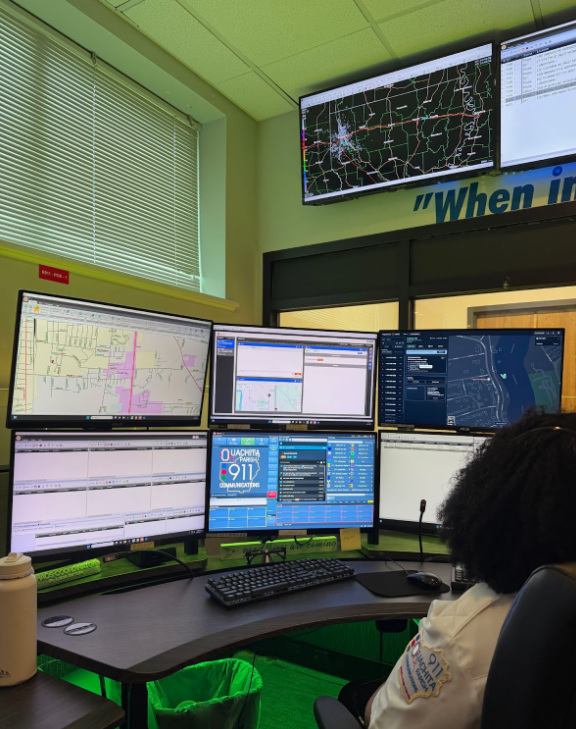
In addition to careful staffing, Motorola Solutions technology plays a key role in disaster preparedness: “The 911 technology helps us because it’s a unified platform,” Gabb notes. “We can use it to quickly transfer information to our many secondary public safety partners, including police, fire and EMS.” As calls flood in during an extreme weather crisis, the Communication Center leaps into action. The telecommunicators triage the calls to determine which jurisdictions they fall into, and also what kind of assistance the caller requires (police, fire or EMS). After they capture initial information from the caller, they transfer the call directly to a secondary public safety partner for dispatch – all via their unified 911 system.
Ouachita’s PSAP is also connected directly to their Real-Time Crime Center (RTCC) via a link between the VESTA 9-1-1 platform and the Ouachita Parish Sheriff’s Office CommandCentral Aware software, which is crucial for high-priority calls. In Gabb’s words, “by connecting the two systems, operators in the RTCC can see the 911 calls for service as they come in. That saves time because we aren’t duplicating efforts, and it means we can provide a more coordinated response.” In establishing this link, the Ouachita Parish 9-1-1 Communications District and Ouachita Parish Sheriff’s Office can work together even more effectively to keep their citizens safe.
To further minimize response times during extreme weather events, Ouachita Parish implemented the Motorola Solutions Call Intake Assist service in 2024, which uses artificial intelligence to automatically transcribe and translate incoming calls in real time. Gabb explains, “One of the biggest challenges we had before was that when a non-English speaker called in, we had to utilize third-party services to figure out key details, which could slow down our response – now, the translation service closes the gap for us and enables us to start arranging the right resources more quickly.”
Another unexpected benefit of Call Intake Assist, according to Gabb, is that the cloud-based AI capabilities eliminate the need for complex logistics between various facilities: “When our RTCC came online, we didn’t have to facilitate physical lines between the Communications Center and the RTCC, which is in a different geographic location. The transcriptions and translation were available on both.”
The combination of unwavering dedication from Ouachita’s telecommunicators and the Sheriff’s Office, and a powerful software platform they can rely on, means that when an emergency strikes – especially during a severe weather event – both teams have the information and connectivity they need to protect their community.