Public safety agencies work tirelessly to help protect people and property from harm. But as the world grows more complex, law enforcement agencies, fire departments and emergency medical teams have had to increasingly depend on advanced technology to help them curb new types of criminal activity, overcome resource limitations and optimize emergency response.
Thankfully, today’s first responders have access to cutting-edge public safety technology designed to help them overcome these challenges, and they’re poised to gain even more benefits from exciting advancements we’re anticipating in 2026.
What is public safety technology?
Public safety technology refers to next-generation hardware and software that enable police officers, firefighters and rescue teams to work faster and smarter. It’s a broad category that encompasses a variety of networked devices and integrated solutions, but each one offers unique benefits that can help public safety agencies keep people and property safe.
Over time, public safety technology has become so integral to policing, fighting fires and pre-hospital care that it’s gone from a helpful resource to a necessary asset.
Police officers:
- Rely more heavily on public safety technology as a shield against evolving digital threats
- Have largely switched from traditional analog scanners to digital encrypted radio systems to protect themselves and their communications
- Have begun to use digital evidence management systems to securely capture, index and share data gathered during investigations
Firefighters:
- Rely more on technology to predict how fires will grow and spread, especially as extreme wildfire activity has more than doubled worldwide over the last 21 years
- Use models that combine generative AI with satellite data, local weather data, and drones equipped with thermal cameras that can see through trees and smoke
- Depend on models to more effectively deploy resources to stop blazes from spreading into populated areas, where they can do massive amounts of damage and harm
Emergency medical services personnel:
- Use public safety technology to help dispatchers and responders address 9-1-1 calls more quickly and effectively — and every second counts
- Rely on public safety technology to help paramedics and emergency medical technicians (EMTs) locate individuals in need of assistance in low- or no-visibility scenarios
- Are increasingly turning to AI-powered transcription and translation tools that help them gain critical situational awareness and begin delivering life-saving care more quickly
Emerging technologies in public safety
While public safety technology comes in many forms, it usually falls into one of three main categories: hardware, software and integrated systems that connect the two.
Here are some of the most advanced devices, software and systems used by public safety agencies today.
Body cameras
These are wearable devices that capture and record audio and video to document interactions between members of the public and police officers or other law enforcement agents.
The presence of body cameras can act as a deterrent to unprofessional conduct from law enforcement and to inappropriate or criminal behavior from community members. Recordings can also be used as evidence, or simply to demonstrate the transparency of a police force.
Drones
Drones are unmanned aerial vehicles (UAVs) that are remotely controlled. Because of their high degree of maneuverability, they can reach elevations that would require human agents to use an aircraft and access spaces that are either impossible or too dangerous for public safety agents to enter themselves.
Drone solutions are used to perform a myriad of essential public safety tasks such as surveillance and reconnaissance, search and rescue missions, crime scene investigation, crowd monitoring, traffic monitoring, forest fire monitoring, drone as first responder (DFR) emergency call response and other highly tactical operations.
Biometric systems
Biometric systems use distinct biological or behavioral markers called modalities to identify or verify individuals. Common biological modalities include DNA, fingerprints, palm prints, iris patterns, facial recognition and voice recognition, and behavioral modalities include gait recognition and signature or handwriting analysis.
These systems are used in law enforcement scenarios where identifying or verifying an individual is critical to mission objectives or a necessary failsafe to prevent administrative error. These include arrest booking, field identification, forensic analysis, vetting and credentialing, granting permissions for travel or trade and border security.
Automatic license plate recognition (ALPR) systems
ALPR systems use powerful, high-speed cameras to scan, detect and capture license plate numbers that enter their field of vision. Each capture is documented along with corresponding details, including date, time and location, then uploaded to a centralized database for later reference or analysis. Captures can also be shared between law enforcement agencies as needed.
Systems like these are used by law enforcement to locate and track stolen vehicles and find missing or wanted persons. License plate readers can be attached to stationary fixtures such as traffic lights or utility poles, mounted atop patrol cars for mobile scanning or built into trailers that police or other law enforcement agencies can move and position along roadways of their choosing for as long as they need.
Security camera systems
Networks of IP cameras can be mounted throughout cities, towns and other municipalities with feeds that run to a central hub known as a real-time crime center (RTCC). Systems often incorporate different types of cameras with unique functionality, including 360-degree rotation, thermal imaging and pan-tilt-zoom (PTZ).
The goal of these systems is to help police departments or other law enforcement agencies to monitor public spaces and pull images or videos as cases demand it. RTCCs also let police officers surgically address locations where routine criminal activity is suspected to intercede, catch lawbreakers in action and make arrests.
Mass notification systems (MNS)
Mass notification systems let public safety agencies quickly send real-time alerts en masse to individuals and organizations endangered or affected by an emergency or other large-scale adverse event. Messages can be sent through multiple channels to guarantee receipt, and recipients can be targeted by select attributes such as geographic location.
Most often, messages sent through these systems are warnings or alerts about pending or imminent danger, and include instructions such as how to recognize suspicious activity or how to get to safety. Depending on the content of the message, a mass notification can come from a local government, police department, fire department or emergency medical team.
Integrated public safety platforms
These platforms unify a number of existing systems, such as computer-aided dispatch (CAD), records management systems (RMS) and communication channels between dispatchers and responders. This creates a single source of truth that connects police, fire and EMS crews with up-to-date information about emergency calls that they can receive while they’re still en route to the scene.
Systems like these make it easier for dispatchers to prioritize and assign the best-fit units in the field for shorter response times. First responders answering a call with pertinent, real-time information about the individuals and environments involved are able to work more efficiently once at the scene and take decisive actions that can save lives.
AI-powered transcription and analysis tools
Technology like AI emergency dispatch software can automatically generate transcriptions of emergency calls in real time, picking up key words or phrases that call takers can miss in the moment and instantly turning calls into searchable documents.
Transcripts save valuable time, as it’s faster for emergency call takers and dispatchers to search documents for incident details than to play back and review hours of recordings. Some systems also include AI-driven summarization tools that make it even easier for police to scan high volumes of recorded calls for details or evidence, freeing up officers to perform other essential policing tasks.
Data analytics platforms
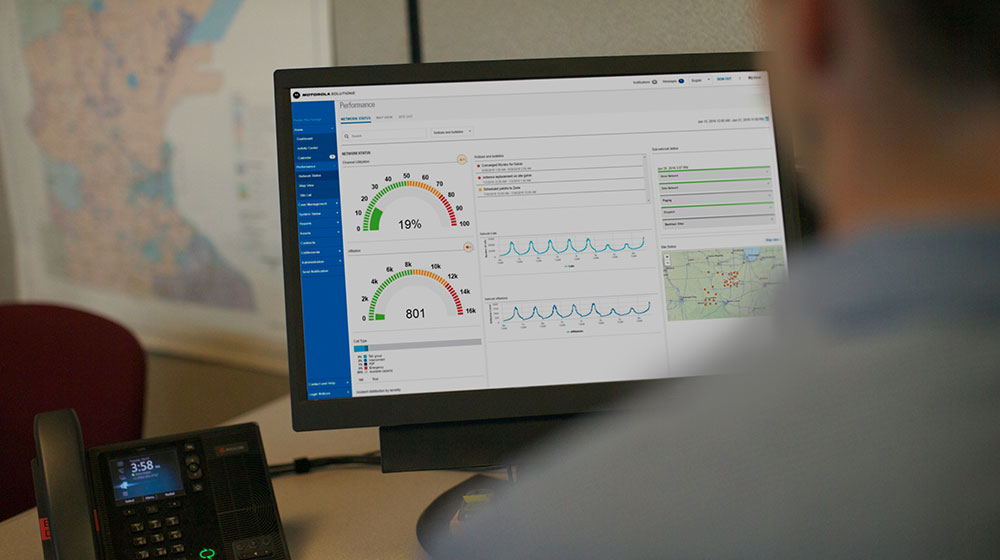
These comb through millions of terabytes of data from first responders, social media and other diverse sources of information to identify patterns and report trends. Many programs also include options for custom dashboards and business intelligence visualization options that make it easier to share learnings.
Some actionable insights that analytics platforms offer to police departments include predictive policing recommendations, such as identifying high-risk physical spaces that may require additional focus, making connections between statements or reports within a case, and making recommendations for improvements to response protocols.
Key benefits of public safety technology
Public safety technology delivers a variety of key benefits that let agencies learn about emergencies or other crises sooner and help them to respond faster and more efficiently.
Some benefits of public safety technologies include:
- Lower crime rate: Surveillance systems can help police departments detect suspicious activity faster, enabling police units to respond more quickly to potential crimes. Additionally, sometimes the mere presence of public safety technology — such as a body camera, drone or ALPR system — is enough to make a would-be criminal think twice and reconsider before performing illegal activity.
- Quicker responses to emergency calls: Drones, integrated public safety platforms and AI-powered transcriptions help police, fire and emergency medical units to learn about emergencies more quickly, more accurately record key incident details and arrive on the scene more informed and ready to act.
- More effective proactive policing: Data analytics platforms can indicate specific areas where crimes are more likely to occur, showing law enforcement where to deploy more resources to prevent crimes. This is true for both physical and digital spaces, where AI solutions for law enforcement can establish patterns and track new and growing types of cybercriminal incidents back to their sources.
- Greater efficiency at incident sites: The chaos and confusion at incident sites is like a “fog of war,” making quality information more difficult to gather. Integrated public safety platforms give emergency responders the necessary real-time data to perform accurate risk assessments, make informed decisions and act with clarity and precision, helping them to save more lives.
Public safety technology trends for 2026
In 2026, public safety agencies are expected to adopt more innovative types of devices and solutions that leverage emerging digital and automation technologies, keeping human agents front and center while filling gaps created by workforce shortages and budgetary shortfalls:
- A cybersecurity-first approach: Cybercriminals try to exploit innovations and get closer to unsuspecting individuals and organizations to gain unauthorized access to their assets or disrupt vital services. As deeply damaging and disruptive crimes are perpetrated more often in digital spaces every year, public safety agencies must meet the moment and elevate their cybersecurity protocols to match.
- Increased AI adoption: Policing, firefighting and emergency response will increasingly rely on AI-powered functionality to gather and assess data, automate repetitive tasks and give time back to first responders, improving overall operational readiness. AI in public safety will also get better at analyzing and interpreting data for criminal activity, fires and medical emergencies, equipping response teams with more accurate information and helping them respond to calls faster and more effectively — but the integration of AI into the core work of public safety must be performed with scrutiny, integrity and care.
- More interconnected devices: The Internet of Things (IoT) is expected to march onward in 2026, with more internet-connected devices deployed by police departments, fire departments and rescue teams to gather data, assess threats and drive response efficiency. Drones are also expected to become a more regular part of emergency response procedures as DFR fleets become more widespread.
- Increased reliance on IT infrastructure: As law enforcement agencies, fire departments and emergency medical care teams use more advanced technology, they will depend more heavily on foundational IT infrastructure. This means they’ll need to perform the same third-party risk management practices to maintain operational resilience — such as business impact analysis (BIAs), dependency mapping and third-party auditing — as organizations in the private sector. Additionally, emergency teams will continue to shift toward supporting technologies that improve scalability and uptime dependability, such as cloud computing for data storage.
- Greater transparency: Public safety agencies are under a higher degree of scrutiny from an increasingly polarized public demanding greater accountability. To change the public’s perception, agencies need to meet these challenges head-on and offer transparency whenever possible, and training for the use of these technologies must emphasize accountability, proper usage and the preservation of citizens’ privacy.
Key takeaways
Over time, public safety technology will only grow more fundamental to the job of preserving the public’s health and safety. Each new class of law enforcement agents, firefighters and emergency medical service teams will have more powerful and integrated tools and solutions at hand to help them take down threats, minimize danger and save lives.
Considering the frequency and magnitude of cybercriminal activity, wildfires and extreme weather events are all trending up, this is very good news.
But while public safety technology has great potential for security and safety, it must also be used strategically and with a steady hand. Police officers and other first responders must do what it takes to fulfill their public safety responsibilities while affirming that they deserve the public’s trust.